Lansing: Fact-Checking the March 23 City Council Meeting
LANSING, Mich. — At the March 23 City Council meeting, which included a public hearing on the Deep Green land sale, the developer's CTO told the Lansing City Council the project would generate $900,000 in property tax revenue for "roads, public safety, schools, libraries and more." The mayor promised $400,000 for the fire department from project revenue. Neither claim survives contact with the public record.
Claim: "Nearly $900,000 a year in annual local property tax revenue, which supports local public services like roads, public safety, schools, libraries and more."
— Matt Craggs, Deep Green CTO, March 23 presentation
The projected property tax figure comes from a LEAP tax analysis that used 55% of market value as the assessment basis. Michigan law sets State Equalized Value at 50% of true cash value (MCL 211.27a). Using 55% inflates the projection by approximately 10%.
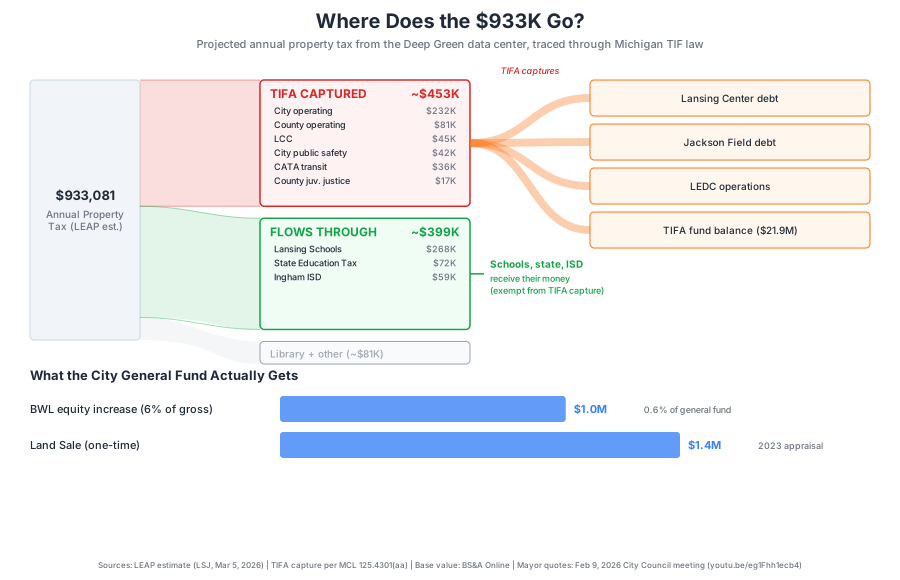
The property sits in the Downtown TIFA district. At the same meeting, Council Member Ryan Kost asked Mayor Andy Schor how much of the property tax actually reaches the city's general fund. Schor said "about $200,000" goes to the TIFA. A millage-rate calculation using the LEAP assessed value shows the actual TIFA capture is closer to $453,000, including $232,000 in city operating taxes and $42,000 in city public safety taxes. Schor understated the city's own captured revenue by roughly $74,000, and the total capture by more than double.
The $900,000 headline figure does not reach "roads, public safety, schools, libraries" as stated. Nearly half is captured by the TIFA for Lansing Center debt, Jackson Field debt, LEDC operations, and a fund balance that already holds $21.9 million. The remainder is split across schools, county, community college, ISD, library, and the city's general fund.
Claim: Water usage of "less than 500,000 gallons of water a year at this site, equivalent to 10 residential homes or a small restaurant."
— Matt Craggs, Deep Green CTO
This refers to makeup water for the closed-loop cooling system, not total water consumption. Deep Green's presentation compared the figure to hyperscale data centers that use water equivalent to entire cities. The 500,000-gallon figure has not been independently verified by the city or BWL. The comparison to "10 residential homes" is based on "data we've got from BWL on average usage," per Craggs. No independent analysis of water usage was presented to the council or included in the buy-sell agreement as a binding limit.
Claim: Fuel cells "reduce sulfur dioxide and nitrogen oxide emissions by over 99.5% and carbon dioxide emissions by nearly 50%."
— Matt Craggs, Deep Green CTO
Craggs said these figures were "calculated based on the EPA's eGrid database comparing fuel, solid oxide fuel cells to the MISO non-baseload marginal generation unit." This comparison measures the fuel cells against the dirtiest power on the regional grid, not against the grid's average emissions or against no emissions at all. The fuel cells are powered by natural gas. They produce carbon dioxide. The "50% reduction" means 50% less CO2 than burning the same gas in a conventional power plant, not 50% less than the status quo without a data center.
Jerry Norris, an engineer, testified that methane fuel cells still emit 60 to 70 percent of the CO2 that direct combustion would produce. Isabella Croff, in written public comment, noted that "90% of that heat would come from these fuel cells and not the data center itself. The data center is incidental."
Claim: "We aren't a hyperscaler data centre... we're 50 times smaller."
— Matt Craggs, Deep Green CTO
The presentation slide stated "500 times smaller" but Craggs corrected himself to "50 times smaller, sorry, that's a typo." At 24 MVA, the facility is smaller than hyperscale campuses. But the comparison to hyperscalers sets the bar at facilities that consume power equivalent to small cities. Being 50 times smaller than something enormous is not the same as being small.
Claim: Bloom fuel cells are "certified by UL laboratories" and "meet fire code, building code, electrical code."
— Marisa Blackshire, Bloom Energy VP Environment & Regulatory, March 23 testimony
Blackshire flew in from San Jose to address fire suppression and safety, describing UL certification, remote monitoring, and shut-off valves. UL certification covers the equipment's electrical and fire safety design. It does not address how the company handles the waste products those systems generate, which is the subject of the next claim.
Claim: "Fuel cells do not contain, require the storage of, or generate any toxic chemicals."
— Marisa Blackshire, Bloom Energy VP, written letter to Council, March 22, 2026
This statement is false. The EPA has designated Bloom Energy as a Large Quantity Generator of hazardous waste, a classification that applies when a facility generates more than 2,200 pounds of hazardous waste per month. The waste includes benzene, chromium, and lead, and the EPA fined the company $1.37 million for mishandling it. Bloom was also sued in 2016 by Unicat Catalyst Technologies for allegedly dumping toxic benzene into the Sunnyvale, California wastewater system.
Blackshire sent this letter to Council Member Nevarez Martinez on March 22, copying all eight council members, the mayor, the city clerk, BWL, and Deep Green. She oversees Bloom's environmental compliance program.
Her letter described the desulfurization canisters used in fuel cell systems as "Excluded Recyclable Material" shipped to a recycler in Indiana, not hazardous waste. The canisters contain copper catalyst material that filters sulfur compounds from natural gas and require replacement every 15 to 36 months, but no site-specific waste characterization for the Lansing installation has been presented to the council.
Claim: Fuel cells will operate reliably for a 20-year BWL contract.
— Implied by Deep Green and Bloom presentations
Hindenburg Research documented in 2019 that post-2017 Bloom fuel cell stacks had a lifespan under three years. Bloom's Delaware installation was decommissioned after approximately seven years, against an expected lifespan of 15 to 21 years. Bloom restated its financials for the 18-month period surrounding its IPO, acknowledging "material misstatements" in its SEC filings. Delaware State Senator Harris McDowell told reporters: "I think we were sold a bill of goods."
Claim: Steve Purchase spoke "in my personal capacity as a 20-year resident."
— Steve Purchase, March 23 public comment
Purchase identified himself as serving on the Board of Fire Commissioners and the Board of Michigan Climate Jobs. He did not disclose his day job. Purchase is the Communications Director for the Michigan Regional Council of Carpenters, a building trades union whose members benefit from construction projects. He was endorsed for the Lansing Charter Commission by the same labor-business coalition that ran Vote Yes Lansing 2025. A union communications professional testified in favor of a union-beneficial project while presenting himself as a concerned citizen.
Claim: The supplemental budget would direct $400,000 to the fire department from Deep Green revenue.
— Mayor Andy Schor, March 23 budget presentation
The mayor specified this would fund "specialized gear for electrical hazard mitigation, chemical spill response, confined space rescue, high angle rescue certifications, electrical hazard, HAZMAT, and additional personnel." These are capabilities needed to respond to incidents at a facility with fuel cells, glycol cooling systems, and high-voltage electrical infrastructure.
The $400,000 does not appear in the FY27 Budget Resolution, was not submitted as a written amendment, and was not referred to the Committee on Public Safety. It exists only as a verbal proposal made at the same meeting as the Deep Green public hearing. Council Member Nevarez Martinez asked the mayor whether the HAZMAT funding was "in preparation because we may not have the HAZMAT available needed in case this blew up." The mayor's response: "It was, well, it was general."
Claim: "We will not seek any local tax incentives or abatements from the city throughout the lifetime of the project."
— Matt Craggs, Deep Green CTO
This is accurate as stated. The buy-sell agreement includes this commitment. However, the property tax revenue generated by the project is largely captured by the Downtown TIFA rather than flowing to the city's general fund, which functions similarly to an abatement from the city's perspective. The city receives no property tax abatement because the TIFA captures the increment before the city's general fund sees it.
Claim: The aesthetic commitments (windows, landscaping, murals, public park, walkability) are protected by the buy-sell agreement.
— Multiple Deep Green presentations
Council Member Adam Hussain asked directly whether these features are required in the buy-sell agreement. Deep Green CTO Matt Craggs could not confirm they were. Legal counsel Elizabeth Rogers pivoted to site plan review as the protection mechanism. Hussain responded: "If it's not a requirement in the buy-sell, if some legally binding contract between us and the company, then that's not something that we can actually promise the public will happen at that location." The buy-sell agreement requires compliance with DT-3 zoning standards, which address setbacks and construction materials but do not require windows, murals, intentional landscaping, or a public park.
Public Comment
Forty-three members of the public spoke against the project. Six spoke in favor. Of the six supporters, two were officers of UA Plumbers and Pipefitters Local 333 (Business Manager Dustin Howard and Inside Guard Derek Wright, per the union's LM-2 filing, DOL File 541-123), one was Steve Purchase (Chair of the Board of Fire Commissioners and Communications Director for the Michigan Regional Council of Carpenters), one was an engineer citing technical feasibility, one was a resident making an economic argument, and one was a longtime resident citing property tax revenue.
Nearly half the tax revenue is captured by the TIFA before it reaches any of the services Deep Green listed, the aesthetic commitments Craggs promised are not required by the buy-sell agreement, and the $400,000 in fire department funding exists only as a verbal proposal that is not in the FY27 budget. Forty-three residents spoke against the project. Of the six who spoke in favor, five have direct financial or organizational ties to the building trades unions that would benefit from construction.
Sources
March 23, 2026 City Council meeting, CivicClerk Event 7881 (transcript, agenda packet, presentation slides, FY27 Budget Resolution civic_item_29563). MCL 211.27a (State Equalized Value). TIFA capture calculated from Ingham County millage rates applied to LEAP assessed value per MCL 125.4301 (Tax Increment Financing Act). TIFA fund balance from Downtown TIFA annual report. Bloom Energy letter to Council, March 22, 2026 (civic_item_29568). Hindenburg Research, "Bloom Energy: A Broken Bloom", September 2019. Bloom Energy SEC 10-K filings. EPA hazardous waste enforcement records. UA Local 333 LM-2 Annual Report, DOL File 541-123, OLMS. Steve Purchase: LinkedIn (MI Regional Council of Carpenters). Chamber endorsement slate, 2024. Public comment count from full meeting transcript review.